


This edition of The Work-Life Harmony series at Club 12 was brought to you by 1-2-5 Method™. Get premium paper-based productivity tools that compliment your digital workflow. Made in California, USA.
Work-life balance is one of the biggest lies you’ve ever been sold. In theory, a “balanced” life seems like the ultimate dream: when everything is in balance, you’ve got enough time for work, family, friends, recreation, health, and personal growth. The idea of doing it all and having it all by balancing it all sounds incredible... Until you realize that keeping every part of your life in perfect balance is unachievable.
No one has a static life. Life is dynamic, cyclical, and full of surprises.
And that’s what makes work-life balance a pipe dream.
Just think about it:
Is your life balanced?
Has it ever been?
Probably not.
Because that simply isn’t how life works for anybody.
Life is seasonal.
And different seasons call for different approaches:
If you start a new business or take on a massive project at work, you’re in a season of action… A season that requires you to spend more time than usual at work, which naturally takes time away from the other parts of your life.
If you experience the loss of a loved one, it changes what you’ve got the capacity to handle, which throws you into a season of reflection, patience, and healing.
If you have a baby, that puts you in a caretaking season – and as any parent knows, nothing throws your life out of balance like a newborn child.
If you experience a health challenge of some kind, that forces you into a different season – one in which you’ll need to dedicate an outsized amount of time toward improving your health, eating well, and exercising or rehabbing your way back to better health.
I could throw examples at you all day long.
But the idea is this: the scales of work and life are constantly moving, evolving, and changing. Sometimes, these changes are in your control, and sometimes they’re not.
One thing I know for sure though, is this: achieving work-life balance by equally distributing your time across every area of your life sounds ideal, but it isn’t real.
When you measure yourself against the scales of balance, you will always lose.
Because something almost always comes along to knock you out of balance. And if balance is what makes you feel fulfilled and successful, you’ll be in a constant state of course-correction: every time something puts a wedge in your idea of a “balanced life,” you’ll want to fix it so you can get back into balance. And those constant adjustments can quickly begin to feel like personal short-comings or failures…
As soon as you find yourself giving more attention to one area, you immediately find yourself feeling guilty about the time it takes away from another.
When you accept the paradigm of work-life balance, even the right choices can feel wrong.
Here’s what the author Keith H. Hammonds says about balance:
“The truth is, balance is bunk. It is an unattainable pipe dream, a vain artifice that offers mostly rhetorical solutions to problems of logistics and economics. The quest for balance between work and life, as we’ve come to think of it, isn’t just a losing proposition; it’s a hurtful, destructive one. […] Instead of trying to balance all of our commitments and passions at any one time, let’s acknowledge that anything important, and anything done well, demands our full investment. At some times, it may be a demanding child of an unhappy spouse, and the office will suffer. At others, it may be winning [an] account, and child and spouse will have to fend for themselves. Only over time can we really balance a portfolio of diverse experiences.”
Work-life balance has two big limitations:
First, it comes with an expectation that everything in your personal and professional life needs to get equal attention and remain neatly in place.
Second, work-life balance places ‘work’ on one side of the scale, and ‘life’ on the other.
But your life, including your work, is far more connected than that:
A tough day at work can have an impact on how you feel when you get home.
A thought-provoking conversation can change how you approach the rest of your day.
A walk with someone you love can support your health and your relationship at the same time.
These parts of your life have an influence on one another.
It isn’t a question of balance; it’s a question of integration and prioritization.
To get your life in sync – to feel fulfilled in life and successful at work – we need to prioritize what matters most and get the different parts of our lives working together.
So, let’s throw away the idea of achieving work-life balance and replace it with a new paradigm – one that I refer to as, Work-Life Harmony.
Work-life harmony
Unlike work-life balance, work-life harmony is NOT about giving each area of your life equal time.
It’s about giving the right things, the right amount of time + energy, at the right time.
Read that again.
Life isn’t balanced.
Life is cyclical and seasonal.
Some seasons require you to put more time into your career/business bucket.
Other seasons might pull you into focusing on your family, your health, yourself, or your relationships.
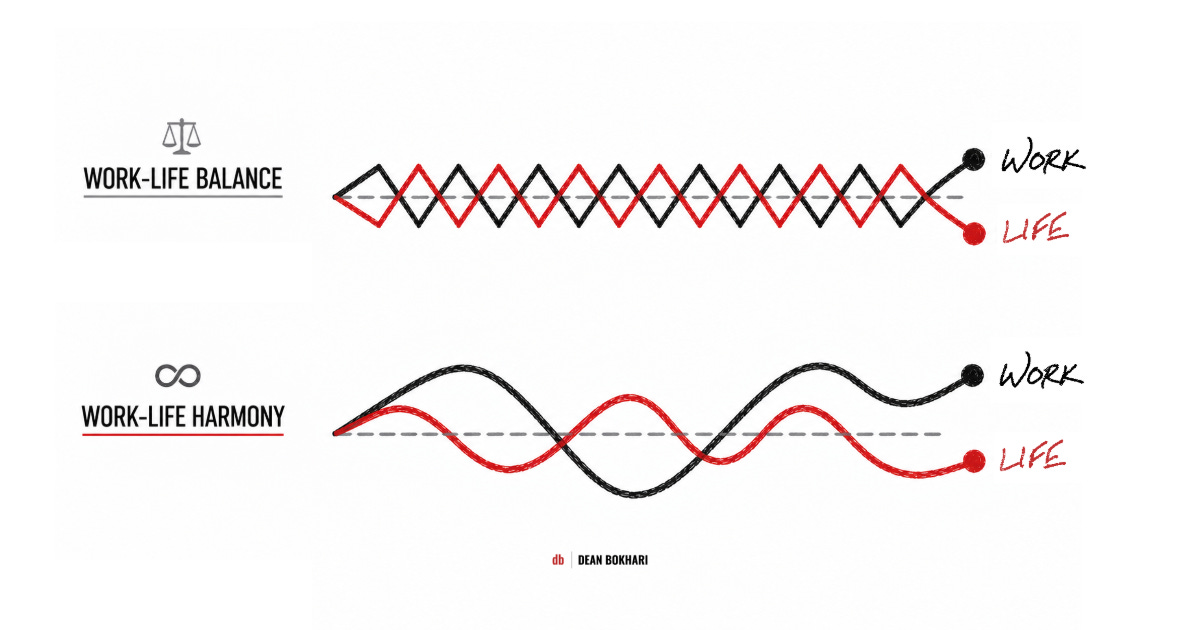
When your work and life are in harmony:
You make conscious choices about what to focus on in this season of your life.
You block off time for your health, relationships, recreation, and personal growth.
You carve out time for your highest priorities at work.
You stay flexible and adjust when an important part of your life isn’t getting the time and energy it needs.
Sometimes, making this happen requires changing your schedule. Other times, it requires saying no, asking for help, or having an honest conversation about your current workload.
Harmony looks different for everyone.
Each of us needs to find the right fit, or work-life mix.
If we get that mix wrong, it stresses us out.
Work-life harmony gives you the flexibility to make adjustments while staying connected to what matters most to you. Harmony also asks you to notice when “just a busy period” has become an ongoing pattern of neglecting yourself or the people you love.
Stop “shoulding” all over yourself
In this first part of this 5-part work-life harmony series, we’re going to look at any unhelpful expectations (or “shoulds”) you might be carrying around about your work and life – and decide which ones actually help you, and which ones you need to let go of.
By the time we’re done here, you’ll have:
a clear picture of what harmony looks like for you (something that fits your actual life), and
one change you can begin making today to begin building a more harmonious personal + professional life.
Let’s get into it.
Finish this sentence in your mind:
“I should be able to...”
What’d you come up with?
Here’s what I’ve heard from others after asking them to do this:
“I should be able to handle everything myself.”
“If I’m doing well at work, I should be able to do equally well everywhere else.”
“I should be able to get ahead at work without ever disappointing anyone at home.”
“I should be able to relax – but only after everything is finished.”
That last one can keep you waiting awhile, because there will always be another task to tend to, another email to reply to, another chore to do, another thing optimize – it never ends.
Take a second to imagine your day tomorrow…
Imagine that you’ve had an insanely productive day in which you handled all the most important work you were committed to doing.
After you’ve taken care of the things that needed your attention, you decide to sit down for a few minutes for a well-deserved break.
But just as you take your seat, you start thinking about the cupboard you haven’t organized, and suddenly, taking a break makes you feel irresponsible.
Take note of what’s happening in your head in that moment:
You’ve shifted your focus from:
“Now that I’ve handled my most important work, I’ll rest for a little bit.”
to“How irresponsible of me to want to rest when I should be organizing the damn cupboard – I can’t take a break until I’ve done it all!”
That’s a self-imposed expectation worth questioning.
You’ve got to stop “shoulding” on yourself.
Take a minute to identify an expectation (or a “should”) you’ve been using to judge yourself.
As you do this, look for any absolutes in your terminology: words like “always,” “everything,” or “everyone.”
You might catch yourself thinking, “I should always be available whenever someone needs me.”
Challenge that expectation if it doesn’t serve you:
Expectation: “I should always be available whenever someone needs me.”
Challenge: Available for what? For who? And under which circumstances?
Now, compare that expectation with what you need right now - during THIS season of your life.
A genuine emergency is different from a request that can wait. An agreement you’ve made is different from a last-minute request you haven’t discussed in advance. Being responsible includes understanding those differences.
To lead a harmonious work and life, you’ve got to develop the ability to recognize which season you’re in at any given time.
Your season is simply the set of circumstances you’re living through currently:
The roles, goals, and priorities you’ve got your plate right now.
Any current demands on your energy, attention, and time.
Your willingness + capability to fulfill your responsibilities.
Maybe you’ve just taken on a very demanding role at work.
Maybe you’re raising young children.
Or maybe things have finally slowed down for you in life, but your mind hasn’t realized it and you’re still acting like every moment needs to be as productive and efficient as possible. (FYI: Packing your calendar with a bunch of bullshit will not fulfill you.)
Whatever your situation is, I suggest asking yourself the following question:
“What has changed that my expectations haven’t caught up with?”
You might be judging yourself against a past version of yourself that had fewer responsibilities. Or you might be comparing yourself to someone whose got a support system that you don’t have, with obligations that are completely different from yours.
Comparing yourself with others (and even with an older version of yourself) can keep you from making the right decisions for the season you’re in right now.
Look at your CURRENT circumstances RIGHT NOW:
What needs more attention right now?
What are you trying to maintain just because that’s how you’ve “always” done it?
And where do you need support?
If you’ve got an insanely demanding workload right now—the kind that’s stressing you out because it’s more than you can handle—thinking positive about it won’t make it go away…
What you probably really need to do is clarify your priorities, move your deadlines, and delegate the rest.
Recognize the season you’re currently in
Recognizing your season helps you see the changes you need to make. It also gives you a reason to revisit your arrangements when your circumstances change down the line.
Otherwise, “I’m just busy right now” can become the explanation you keep giving, without improving anything.
This brings me to a question I want you to spend some time with:
“What would ‘enough’ look like right now?”
If you’re ambitious, that question might make you uncomfortable. You might hear “enough” and think, “But I want to keep growing.”
Good. I want you to keep growing as well. Reframe it as, “better done than perfect” and realize that you can pursue a demanding goal and still decide what completing today’s big priority looks like. That decision gives you a point at which you can turn your attention to something else that matters in your life.
Some examples:
At work, let’s say you need to submit a proposal. You know exactly what needs to be in the proposal and you include it. Then you double-check it for quality. Then you send it in. That’s it. Job done. If you were to keep tweaking it and adding optional improvements, the task might take up the time you intended on reserving for something else.
At home, “enough” might mean the kitchen is clean, usable, and basic things like the dishes are all handled. That drawer you’ve been meaning to organize can wait while you have dinner.
In your relationship, “enough” for this evening might be spending time together without checking your phones. You don’t need an elaborate plan to give someone your attention.
When you ask a question like, “What does ‘enough’ look like right now?” you’re choosing a standard you can recognize and take action on. You can modify that standard when the situation requires it.
You’re on your way to harmony.
Here’s another question for you:
“What would taking good care of what’s most important look like under my current circumstances?”
Let me share an actual example of someone I’m coaching privately right now. Let’s call her Sophia (I won’t disclose her real name for privacy reasons, obviously).
Sophia works full time and has recently started helping an elderly parent recover from an illness.
Before this happened, she had more time to maintain her home, for her friends, and for her personal interests. But now, she’s got a constant list of doctor’s appointments to arrange and additional responsibilities to handle.
But Sophia hasn’t updated her mental “software” yet. She’s still judging her days by her old expectations:
She should be just as productive at work as she was before.
The house should look just as pristine as it usually does.
Every invite she gets should be responded to with a gleefully enthusiastic YES.
And asking for support? Ha! That shit’s for the birds.
“Asking for help feels like I’m admitting defeat,” she told me.
And this is why, by the end of the day, Sophia can name seven things that got done and still feel guilty over the three that didn’t.
Sophia was stuck in an unhelpful work-life balance paradigm.
As I worked with her, we slowly started making changes.
One of the first things we worked on was to help her recognize and internalize the fact that she’s in a different season than before.
When she finally acknowledged her current season, she said:
“I’m carrying a significant responsibility that I wasn’t carrying before. My father needs me.”
Awesome. Now we’ve got something to work with.
After she acknowledged her current reality (season), we worked on making a few practical adjustments to her work and life:
She has a half-brother that lives nearby who agreed to take over one of the weekly appointments for her father.
She let go of her obsession with perfectly organizing everything in her house herself and found a local housekeeper through an app to come by once a week.
And at work, Sophia began prioritizing like a boss. She got clear about her one most important project right now – and began funneling her time, attention, and energy into that before everything else.
She even began to recognize potential deadline conflicts early and proactively informed her boss about them.
These changes depend on real conversations and available support. They take real effort. And some of the changes need to be negotiated.
But now, Sophia’s got a far more useful (and harmonious) set of standards each day:
“Work-life harmony right now means meeting my most important and essential commitments, being present for my father, and getting the support I need to take care of myself too.”
Now Sophia has something specific to work toward. It’s also easier for her to notice any additional changes she may need to make down the line.
Obviously, your own circumstances will be different than Sophia’s.
But the question is the same: What definition of work-life harmony would help you make better decisions for this season of your life?
Actionable insights
Grab a notebook or notepad and something to write with. The notes app on your phone or computer works too. Then, carve out ten minutes to complete the four sentences listed below. Keep your answers together. This is the beginning of your very own Work-Life Harmony plan:
1: “I keep expecting myself to __________”
Name an expectation, a “should,” that’s creating unnecessary overwhelm in your life. Be honest and write down whatever unhelpful expectation you live by, even if it makes you uncomfortable.
For example: “I keep expecting myself to finish every task before I take a break.”
2: “My life currently requires __________”
Look at what you’ve got going on right now, during THIS season of your life, and write down what you NEED currently. Doing this helps you decide what you can reasonably expect of yourself.
For example: “My life currently requires me to meet my agreed work commitments and help care for my parent. I need support to keep doing both.”
3: “Work-Life Harmony would look like __________”
Describe something you could recognize in your daily life. “Feeling better” is too vague to guide a decision. “Being able to sit down for dinner without responding to nonurgent messages” gives you a specific change to work toward.
4: “One change I will make today is __________”
Choose something small enough to begin. Here are some examples:
One change I will make today is…… look into hiring help.
… begin delegating low-priority tasks.
… ask a family member to share a specific responsibility with me.
… simplify or automate a handful of nonessential tasks.
… start taking at least one pre-planned break per day while letting an optional chore wait.
If a change has an impact on someone else or an agreement you’ve made, have a conversation. You can say something like, “This is what I’m finding difficult. Here’s what I’d like us to adjust.”
You don’t need to redesign and harmonize your entire life today.
Just give yourself ONE thing to do – make one decision you believe you can carry out within 24 hours, and then act on it.
Then take note of what happens…
Did it help? Was the expectation reasonable? Did you notice a need for more support?
Up next
In Part 2, we’ll look at the main areas of your life and identify how best to harmonize your personal and professional priorities:
Be Your Best,
—Dean
This is a greater article Dean. I wish I would have had access to this kind of information when I was trying to "maintain a Life-Work Balance", it would have given me a different perspective. I can definitely see this article as a great place where people can understand misconception about this subject, and to gain the window into their own truth afterall.
You are SO right Dean. Work life balance is bunk. I am totally ready for work life HARMONY and excited about this series! 💕