


Welcome to Part 4 of The 5 Spiritual Principles of Success, a Club 12 series about putting universal spiritual principles to work in your everyday life so you can live with intention, achieve meaningful goals, and find fulfillment in the process.
Here’s what we’ve covered so far:


Today, we’re looking at the fourth spiritual principle of success:
The Principle of Trust + Reliance.
By the time you finish watching/reading about this spiritual principle of success, you’ll have a simple, repeatable process for solving almost any challenge you experience.
It doesn’t matter what kind of problem you’re experiencing. It could be physical, financial, or emotional. It could be a family issue or a legal issue…
When you put this principle into practice, the stress and anxiety that comes with trying to control every outcome will evaporate.
Hit the play button above to start watching, or continue scrolling to read the written version.
Everything inside Club 12—instantly unlocked 🔓
THE 5 SPIRITUAL PRINCIPLES OF SUCCESS
4. The Principle of Trust
IN ONE SENTENCE
Do everything in your power to take action on your goals and challenges—then detach from the outcome and trust that God or the Universe will deliver to you what’s best for you.
Have you ever watched trapeze artists at the circus?
You know what I’m talking about, right? Those super athletic acrobats that climb 50 feet up and fly and flip off swings suspended in the air.
Each member of a trapeze troupe has a very specific role to play.
There’s the “flyer,” who leaps from the platform…
And then there’s the “catcher,” who waits upside down on the other side.
When the flyer leaps, all she has to do is stretch out her arms and wait for the catcher to catch her.
She’s NOT, under any circumstances, allowed to try and do the catching.
Because, if the flyer tries to grab the catcher’s wrists, she could break them (which would result in both of them tumbling down to their death.)
The flyer needs to focus on flying, and the catcher needs to focus on catching.
The flyer also needs to complete faith and total trust that the catcher’s going to be there to catch her when she needs him.
Think about that for a second. Think about what it takes to be that flyer.
To even get up on that platform, you need to dedicate years of your life to deep and disciplined practice. You train your muscles, overcome your fears, and perfect the momentum of the swing. You endure calluses, sweat, and bruises.
On top of all that, you’ve got to train and work with your catcher.
Putting on a show like this requires total synchrony.
Because if you’re not in sync, you might fall - and your final view of life will be a bunch of people you don’t know, sitting in the stands of a circus show, watching you fall to your death.
So, you put in the training and you work together with your trapeze partner to execute every move flawlessly.
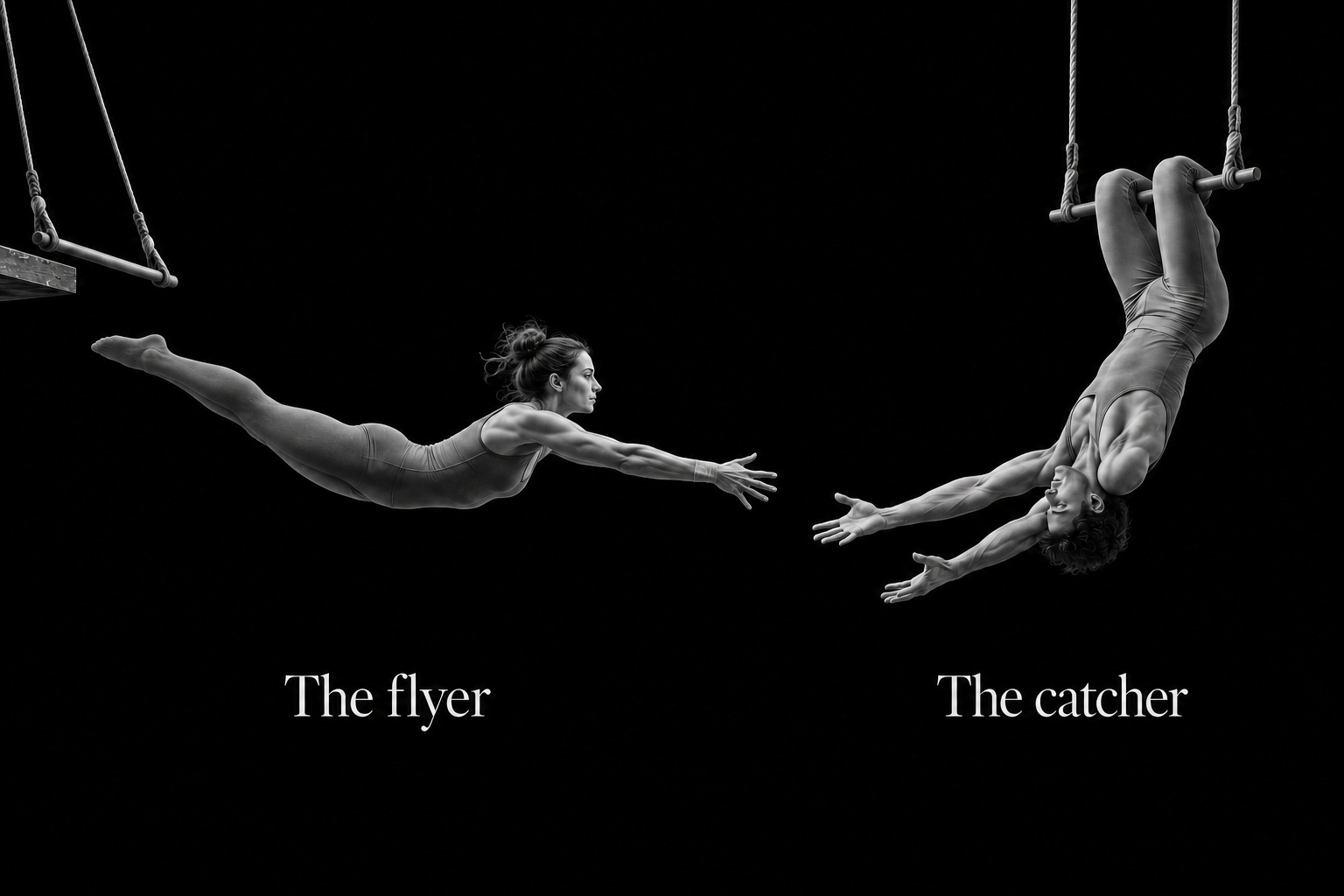
At the apex of a trapeze swing, the flyer has to do something extremely terrifying: she needs to let go of the bar.
Which means that for one horrifyingly long second, she’s suspended in mid-air. Without any assistance - and no net to catch her if she falls fifty feet below.
She has absolutely zero control over what happens next. If she panics in that empty space—if she tries to control the outcome by flailing or reaching for the catcher—she ruins the timing. And she falls.
As the “flyer,” her only job in the air is to remain perfectly still in her surrender. She has to trust the momentum of her effort, and the strength of the hands waiting to catch her.
Can you see how this relates to life more broadly?
In our own lives, we’re terrified of that empty space - when everything’s in the air.
When we launch a business, wait for a medical diagnosis, or try to heal from a trauma… we tend to try and control every single variable.
We try to do the flying AND the catching.
And that’s exhausting.
We burn out trying to micromanage the universe, terrified that if we let go of our tight grip, we’ll plummet to the ground.
Do you know what the opposite of fear is?
It’s not fearlessness.
It’s not courage.
And it’s not love.
It’s faith. It’s trust.
The word I use for this is tawakkul—which means having complete and total trust in your Creator.
Tawakkul is the courage to let go of the bar.
It’s knowing that you’ve done the training, you’ve put in the hours, and you’ve worked as hard as you can.
And once you’ve done that, you’ve got to detach yourself from the outcome and have trust.
This doesn’t mean you stop working hard.
But once you’ve done everything in your control, you’ve got to surrender the outcome (which is outside your control) to the greater guiding force of the universe.
You’ve got to stretch out your arms and believe with absolute certainty that God—or the Universe—will catch you.
How to apply The Principle of Trust + Reliance
Here’s a four-step process to starting applying The Principle of Trust in your own life today:
1. Identify your challenge
Pick ONE problem (or challenging goal) you’re currently facing. Just one. It could be about anything: finances, family, legal issue, what people think of you, your health, etc.
Describe your problem on paper, and then focus your mind on it completely.


